
With an eye for detail, Pia is drawn to the challenge of translating ambitious ideas into carefully resolved spaces. From technically complex justice projects, to bespoke cinema interiors, her work is shaped by adaptability, precision and a close connection to the construction process.
You’ve taken up sewing and making your own clothes. Can you tell me about your latest project, and whether you see any overlap with interiors?
Pia: I do have a cool project, which I think you’d appreciate. I recently finished a pair of pants. [On the videocall Pia spins around in her chair, picks up a pair of pants and holds it up to the camera.]
Rhem: Oh, that’s so cool! They kind of look like chaps, obviously with more coverage.
Pia: Yeah, kind of! They have double fronts (knee patches essentially) with contrasting pockets and top stitching. I wanted layering, heaps of pockets, a hammer loop and a carabiner clip. I just wanted some cool pants that fit me perfectly and are practical.
I don’t know if these pants specifically relate to interiors, but the process does in terms of three-dimensional thinking, planning, detailing and construction.
I start with what I want to achieve visually or how I want it to feel, then figure out how to get there. There’s also the challenge of translating something from 2D to 3D. Pattern drafting starts with flat pieces of paper that you trace onto fabric and assemble into a three-dimensional object. It’s a lot like architectural technical drawings.
Let me show you an example.
Rhem: Oh, they look just like CAD drawings.
Pia: Yeah, So there’s definitely crossover between the two.
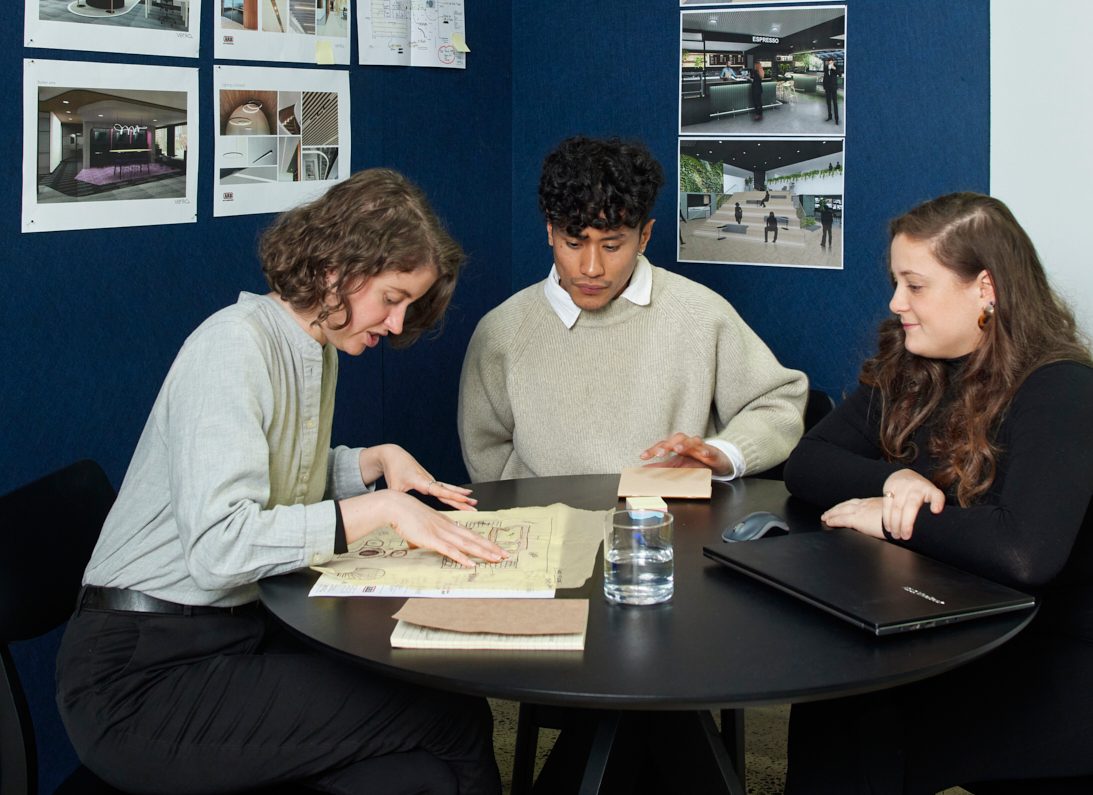
You’re currently working with Court Services Victoria on a new secure docks package, our third package. Can you explain what a secure dock is and talk us through some of the complexities behind the design?
Pia: Yes, sure! A higher jurisdiction secure dock is built for the defendant to sit in during hearings. They need to be visible to everyone in the courtroom.
Most of the time, the dock sits completely open. During certain court sessions, protocol dictates that the people in custody are physically separated from the rest of courtroom, but are still able to fully engage with the proceedings. In those instances, glazed panels come out of hidden compartments and slot into place.
The concern is that placing a defendant in a locked box can subconsciously make them appear guilty, undermining the presumption of innocence.
We’ve delivered quite a lot of secure docks across regional Victoria, but this time Court Services Victoria wanted to build on the previous design. Secure docks 2.0, you could say.
Previously, only the front of the dock was open. This time, they wanted it completely open on three sides where possible, with the glazed panels hidden away when not in use. Court Services Victoria had reviewed its visibility goals, so we went back to Häfele to collaborate and ensure the glazing system could achieve everything they were asking for. The design also includes a fold-out ramp concealed within the wall for wheelchair access, a solution I’m really happy with.
The new docks also couldn’t interrupt court operations. We couldn’t punch into a wall or open the ceiling to investigate the existing conditions, and there weren’t any structural as-built drawings on the last one either.
We had to build the design up from the floor as a freestanding module supporting all the finishes, glazing and audiovisual systems. It incorporates a massive 250 millimetre steel PFC and huge cantilevered beams supporting the glazing. They’ll take the secure dock and weld it together on site with minimal disruption.
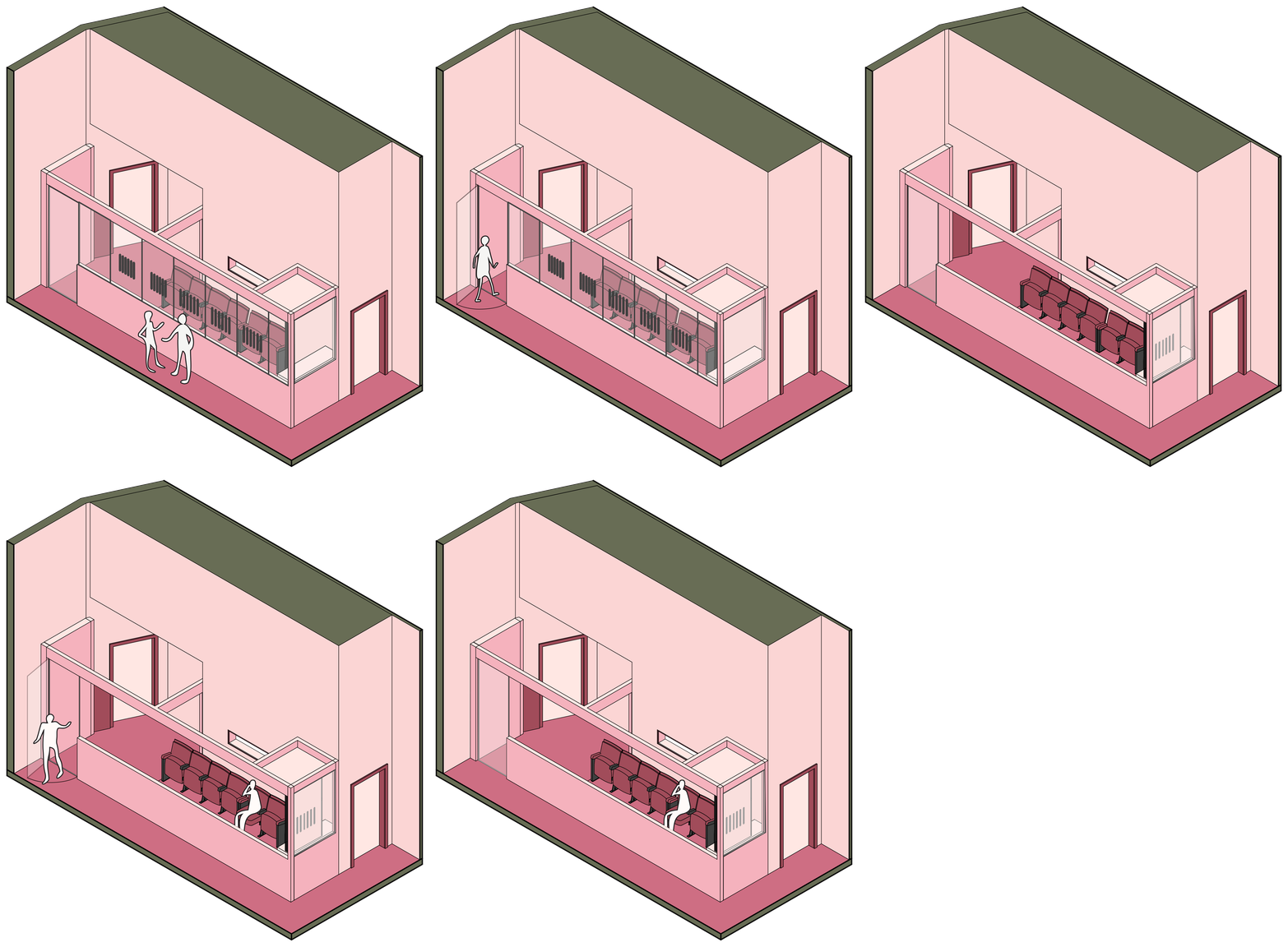
Above: Isometric of the previous secure docks package. Find out more here >
You often lead technically complex projects. What part of that process do you find most rewarding?
Pia: I really do love the details. I love it when they all come together and everything aligns.
We often have these grand ideas, but the interesting part for me is how closely we can align the design intent with the execution on site. I love well detailed joinery or finishes because they allow you to carry the concept through at every scale. When those details are resolved properly, there’s a depth and layering to the design, and you can tell the difference.
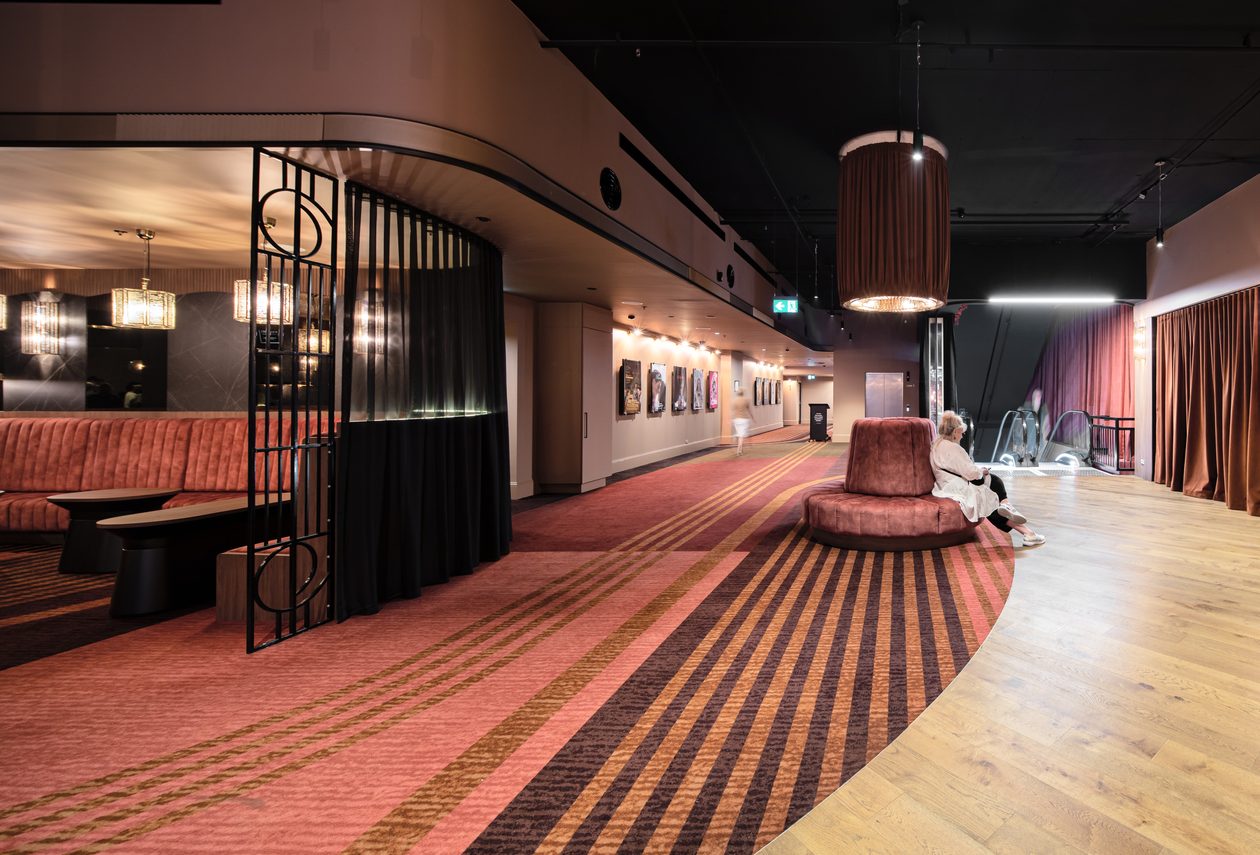
Above: Palace Penny Lane Cinema Moonee Ponds. Find out more here >
The cinema was very much a technical exercise. The architects had allowed space for it within the building, but it was our job to bring the fitout to life. We were essentially given a large, empty space to fill.
Most people probably don’t realise that much of a cinema is built on elevated platforms. The actual slab typically sits at the very front row, so by the time you reach the back of the cinema or the concession stand you might be 1 to 2 metres off the slab. Next time you walk through a cinema, you might notice that your footsteps sound hollow.
It was our job to resolve all of that: the floor heights, stairs, escalators, tiered seating, viewing angles, projection heights, audiovisual requirements and acoustic treatments. At the same time, we needed to deliver the premium cinema experience the client envisioned while remaining aligned with the Palace brand. I learnt so much about how a cinema actually comes together.
My favourite part was the custom carpet (pictured above). It’s a great example of that layering of detail. I designed it around Art Deco motifs and selected custom colours specifically for the project. Those details helped carry the overall concept throughout the cinema.
The cinema was also delivered through an accelerated programme. In practice, we might package two cinemas one week, then move on to the wall finishes while the builders began constructing the previous package. It was somewhat unconventional, but it meant we were constantly resolving the next layer of detail as the project came to life on site.
“We often have these grand ideas, but the interesting part for me is how closely we can align the design intent with the execution on site.”
What simple pleasures of life do you truly enjoy?
Pia: Food! I love wintery food. Stews, soups, Congee, slow cookers, roasts. I have a few comfort foods but my favourite is Burmese Chicken Curry. Its one that I used to eat a lot as a kid. It’s one my parents made a lot. It is so good! I’ll send you the recipe.
Rhem: If you had infinite resources and time what would you make?
Pia: I really miss making croissants. They take time and they’re easy to get wrong. You layer sheets of butter through the dough, fold it again and again, and keep everything cool so the butter doesn’t melt. It’s a difficult process, but that’s what I’d probably make.

Given the choice of anyone in the world, whom would you want as a dinner guest?
I’d probably choose a family member I haven’t seen in ages. I have newly born nephew I haven’t met yet so I’d probably say him.
After a long week what’s your go to guilty pleasure?
Vegging out on the couch or playing video games.
If you were able to live to the age of 90 and retain either the mind or body of a 30-year-old for the last 60 years of your life, which would you want?
That’s hard, but I would probably say mind. I think if you have a sharper mind, you can always improve your physical body.
Speed Round:
- Matte or gloss? Matte
- Complimentary or monochrome? Complimentary
- Burgundy or Terracotta? They both have their place
- Large format or mosaics? Mosaics
- Mural or sculpture? Mural is easier to get over the line so mural hahaha
- Work from home or in office? Work from home.
- Coffee or wine? Coffee
- London or Paris? London
- Beach or snow? Beach
- Night in or a night out? Night out!