
Designing for Universities – Part Three
What are Clinical Training Laboratories?
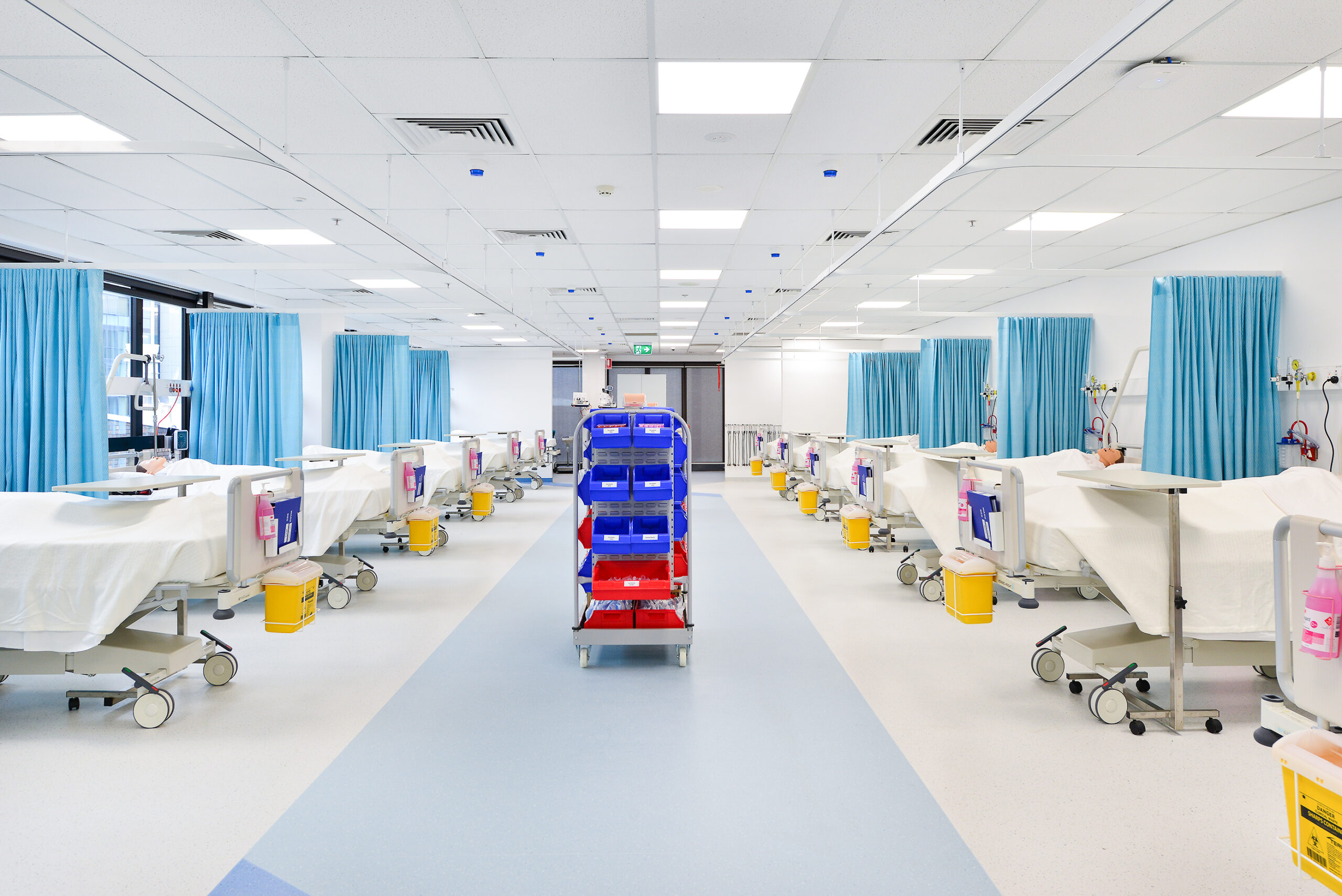
Clinical Training Laboratories are simulated environments where students can practise professional skills. They replicate real-world contexts, from aviation cockpits to moot law courts, micro-teaching rooms, and hospital wards, without exposing students or the public to risk. By delivering consistent training across entire cohorts, they raise the calibre of graduates and prepare them for the demands of practice.
Simulation takes many forms, including manikin-based, non-manikin-based, computer-based, augmented, and virtual reality. This case study features two Clinical Training Laboratories for the nursing schools of Torrens University and Charles Darwin University both feature high and low fidelity manikin-based simulations, widely used in health and clinical education and varying support and learning spaces.
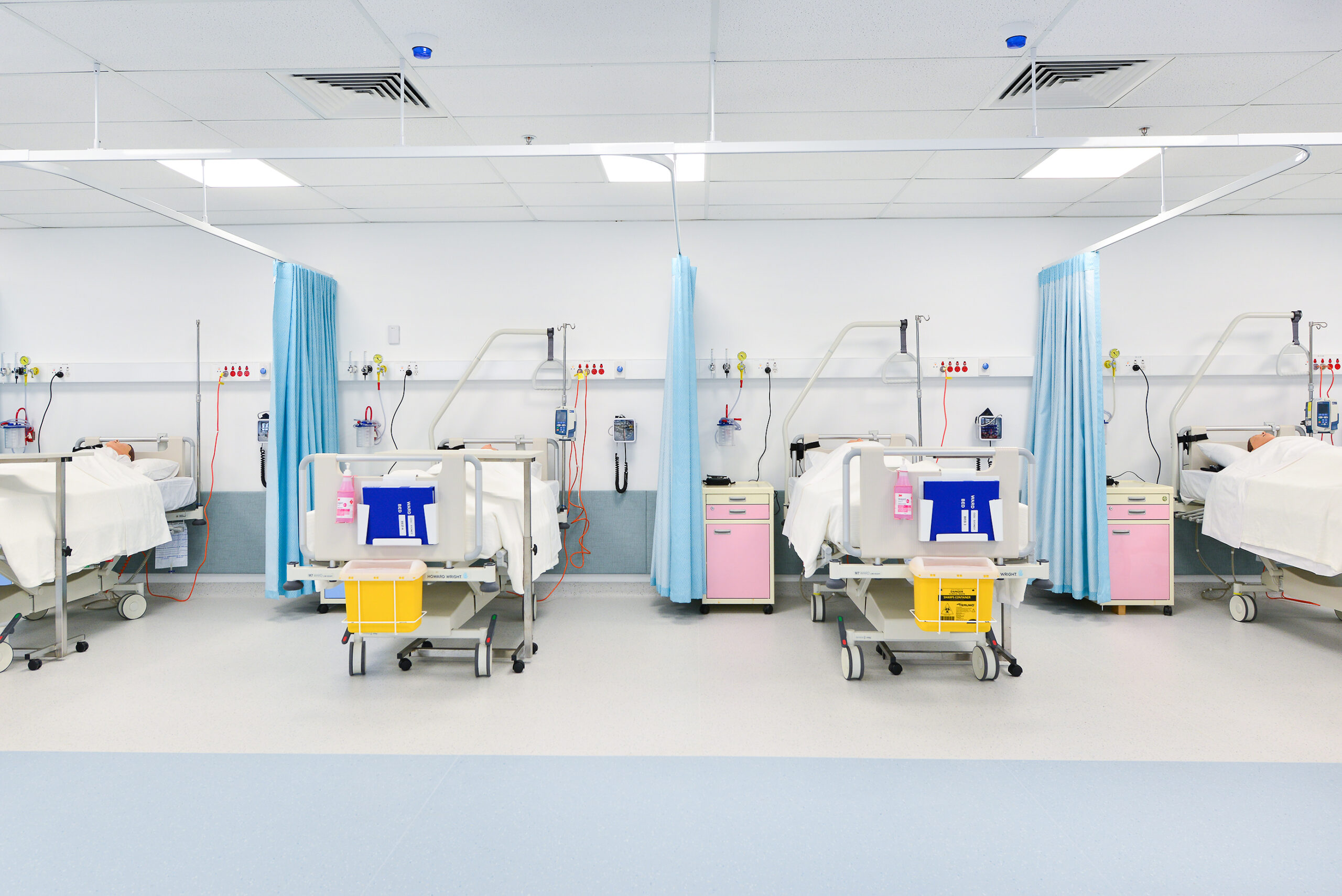
Above: Charles Darwin University, Typical Training Ward
Why do they matter?
Placements in professional fields are limited and highly competitive. Student-led clinics are often reserved for graduates or senior students, and for all students, exposure to complex scenarios can be limited. Simulation laboratories provide a controlled alternative where learning is standardised and accessible to a wider student cross section at scale, ensuring every student receives a high-quality experience. For universities, this strengthens competitiveness, supports retention, fosters best practice habits and produces graduates who are work-ready.
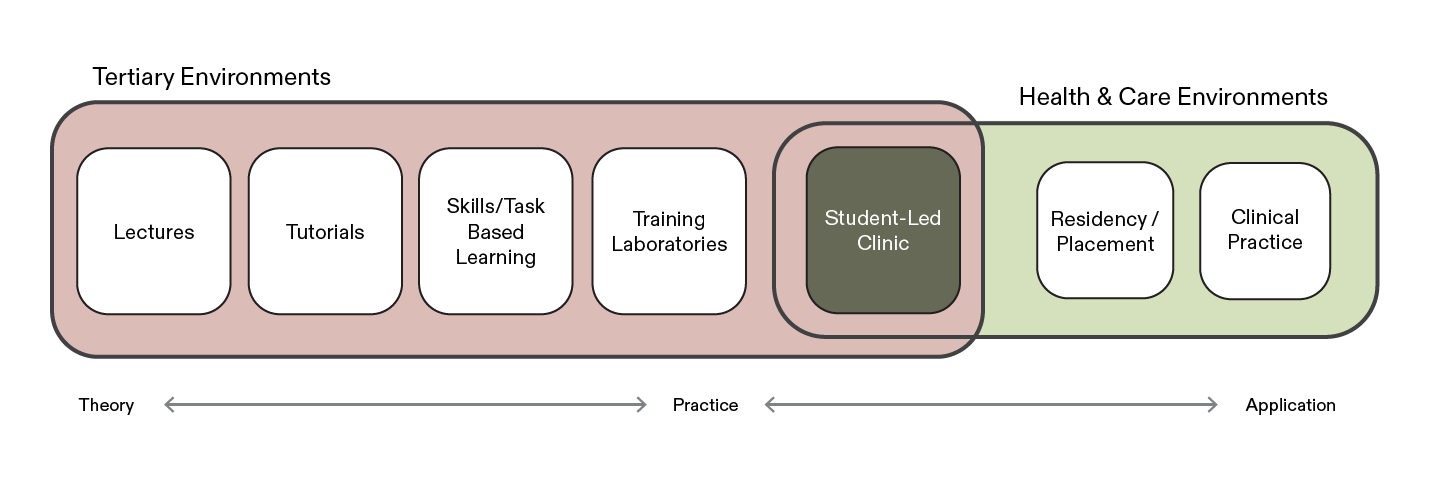
Above: Spatial Typologies from Theory to Practice.
How do they work?
Training laboratories generally follow a three-phase cycle of learning: briefing, simulation, and debriefing.
- Students begin with an introduction to the scenario usually in a classroom or observation room.
- Move into the training labs, depending on the scenario it could be a simulated ward, a support space like a training shower or dispensary or a complex simulation room. If its the latter, a select few will transform into health practitioners for the simulation and the rest will stay in an observation room to watch peers problem solve the unfolding events.
- Once the simulation is complete all students conclude with a reflection and feedback in an observation or classroom.
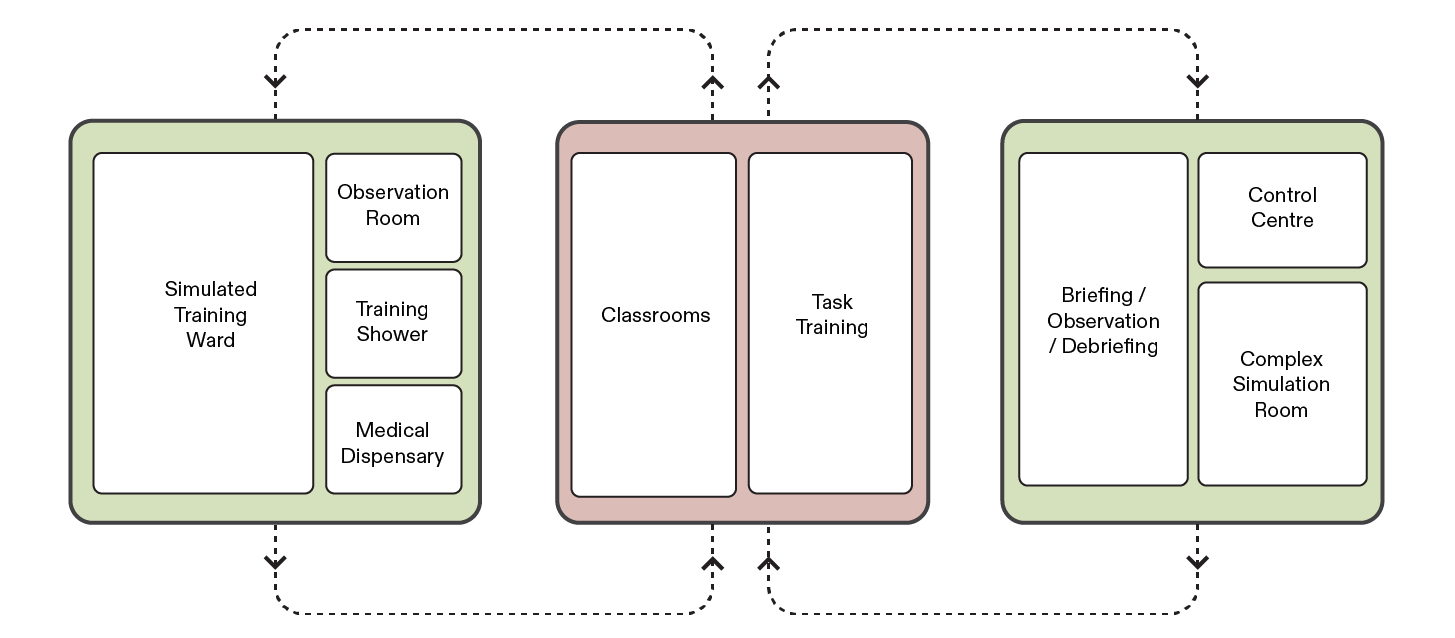
Above: Classrooms to Training Laboratories
Designing for Familiarity
Familiarity can build confidence, spaces that feel authentic allow students to step into professional roles, and reduce the sense of overwhelm when transitioning into practice. These offer a space for these future health professionals to building habits of safe handling, hygiene, and procedural discipline, ensuring that the practice is second knowledge. Our designers will take into consideration the scale of wards, the spacing around beds, bins, the placement of wash stations and glove dispensers. Most often than not the finishes, like the specification of floor vinyl match healthcare standards and are deliberate design choice.
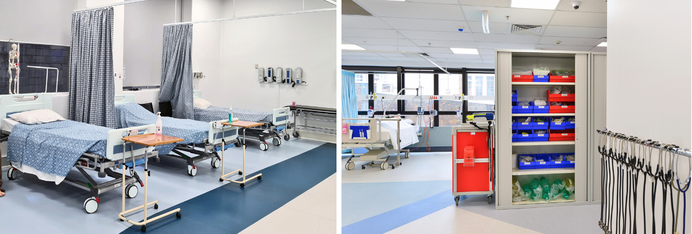
Above: Torrens University & Charles Darwin University training laboratories.
Spatial Typologies
Training laboratories can take many forms. Some are designed for high fidelity, closely mirroring professional environments through advanced technology and complex simulation spaces. Others are more targeted, supporting the development of specific skills through focused environments such as training showers. The value lies not in one approach over another, but in how effectively each aligns with the intended learning outcomes.
The following examples break down a selection of training laboratories designed for Torrens University and Charles Darwin University nursing programs. The Torrens University Nursing School plan below demonstrates how these spatial typologies work collectively and interact within a broader educational environment.
Torrens University Nursing School
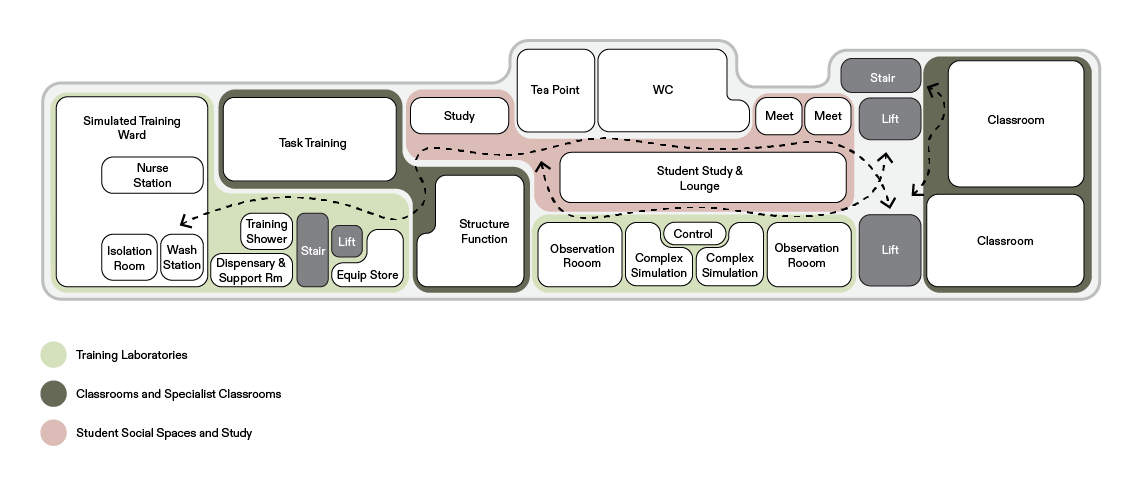
Above: Torrens University, Nursing School Spatial Planning
Simulated Training Ward
These spaces replicate the layout and features of a standard hospital ward, allowing students to practise routine healthcare procedures. With fittings such as nurse stations, wash points, and equipment trolleys, they provide the familiarity of everyday clinical tasks. Low fidelity manikins with basic functions, such as a heartbeat or respiratory movement, support skill development such as vital signs monitoring and oxygen administration.
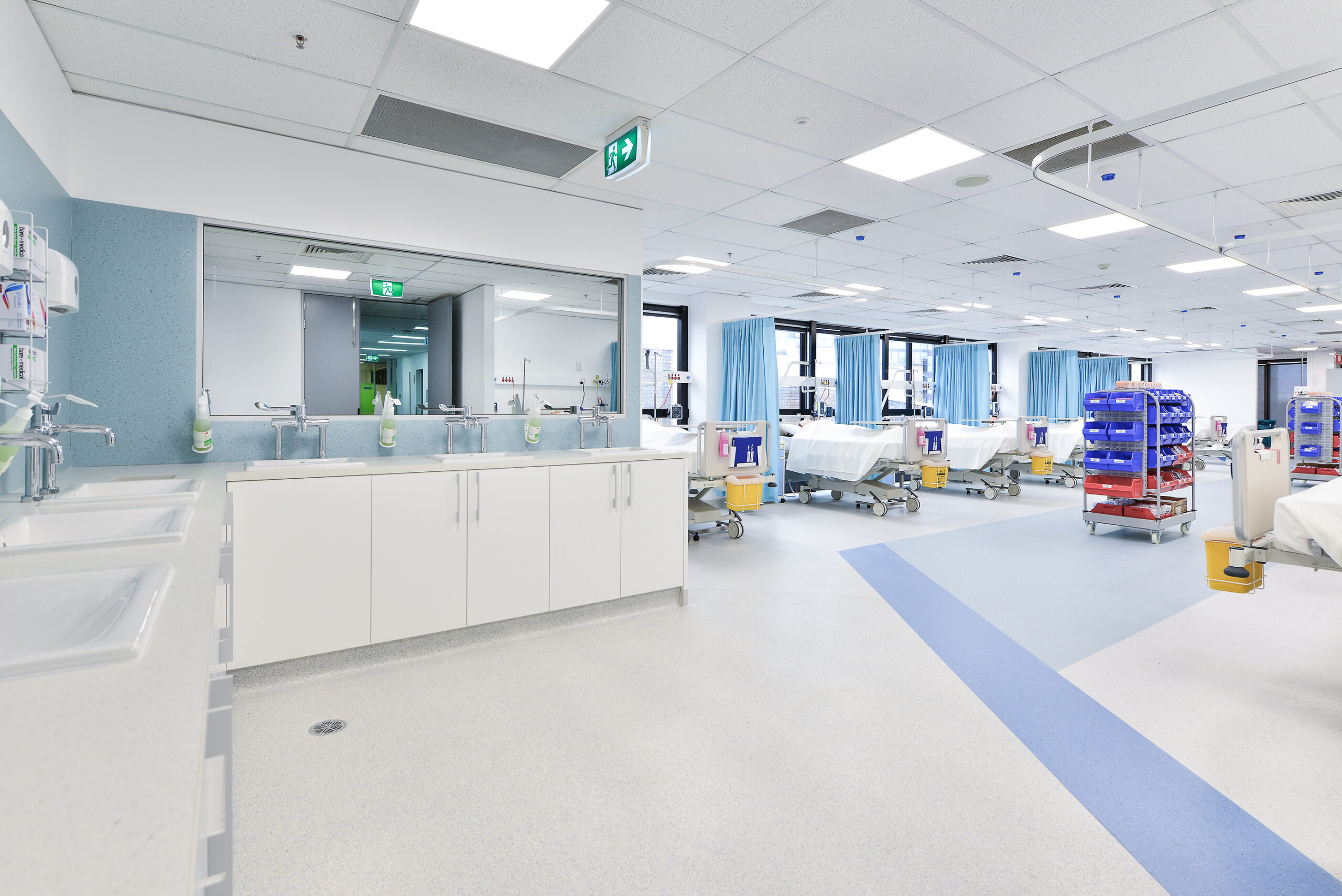
Above: Charles Darwin University, Simulated Training Ward and Wash Stations.
Support Rooms
Located alongside training wards, these rooms address specific aspects of patient care. Typically this can include accessible bathrooms/showers, isolation rooms, medication dispensaries, and equipment stores enable students to practise safe lifting, washing, and handling of patients and medical supplies.
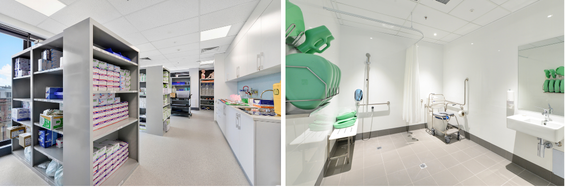
Above: Charles Darwin University, Medical Storage, Prep Space and DDA Shower and Toilet
Complex Simulation Rooms
Designed for advanced procedures, these rooms create lifelike scenarios supported by high fidelity technology. Hospital-standard beds, medical equipment, and sophisticated manikins capable of breathing, speaking, and simulating vital signs establish immersive conditions. Technicians in control rooms can adjust variables in real time, while educators often step into professional roles, guiding students through critical procedures.
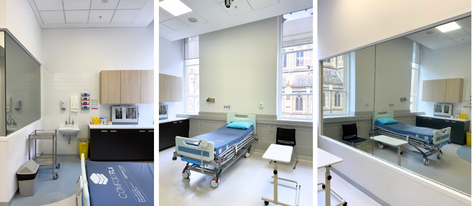
Above: Torrens University Complex Simulation Room.
Briefing, Debriefing, and Observation Room
Located adjacent to complex simulation rooms or training wards, these spaces support observation, preparation and reflection. Positioned behind three way mirrors or connected via live video feeds, students can observe scenarios in real time and analyse clinical responses as they unfold. The rooms also accommodate briefing and debriefing sessions, allowing students to prepare for simulations and reflect on outcomes once complete.
The Greater Tertiary Environment
It’s important to note that Simulation laboratories don’t exist in isolation. They are supported by surrounding environments that contribute to the student experience. At Torren’s the breakout areas encourage informal connection before or after classes, while viewing points allow students passing by to observe a simulation in progress. Classrooms and study areas are located nearby, enabling a seamless shift between theory, demonstration, and hands-on application. While acoustic separation ensures focus study areas remain distraction-free, for deep learning. Find out more about Torrens University’s Health & Nurse Training Facility.
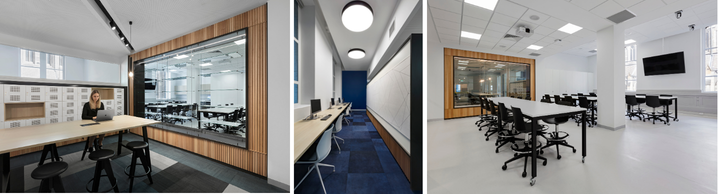
Above: Torrens University Student Study and Classrooms.
Clinical Training Laboratories strengthen professional education by providing safe, authentic environments where students can engage with the realities of practice. Through attention to detail, structured learning cycles, and a diversity of spatial typologies, they create a pathway from classroom theory to professional competence.